
Dating again after a long relationship is often described as frightening, complicated and emotionally exhausting…
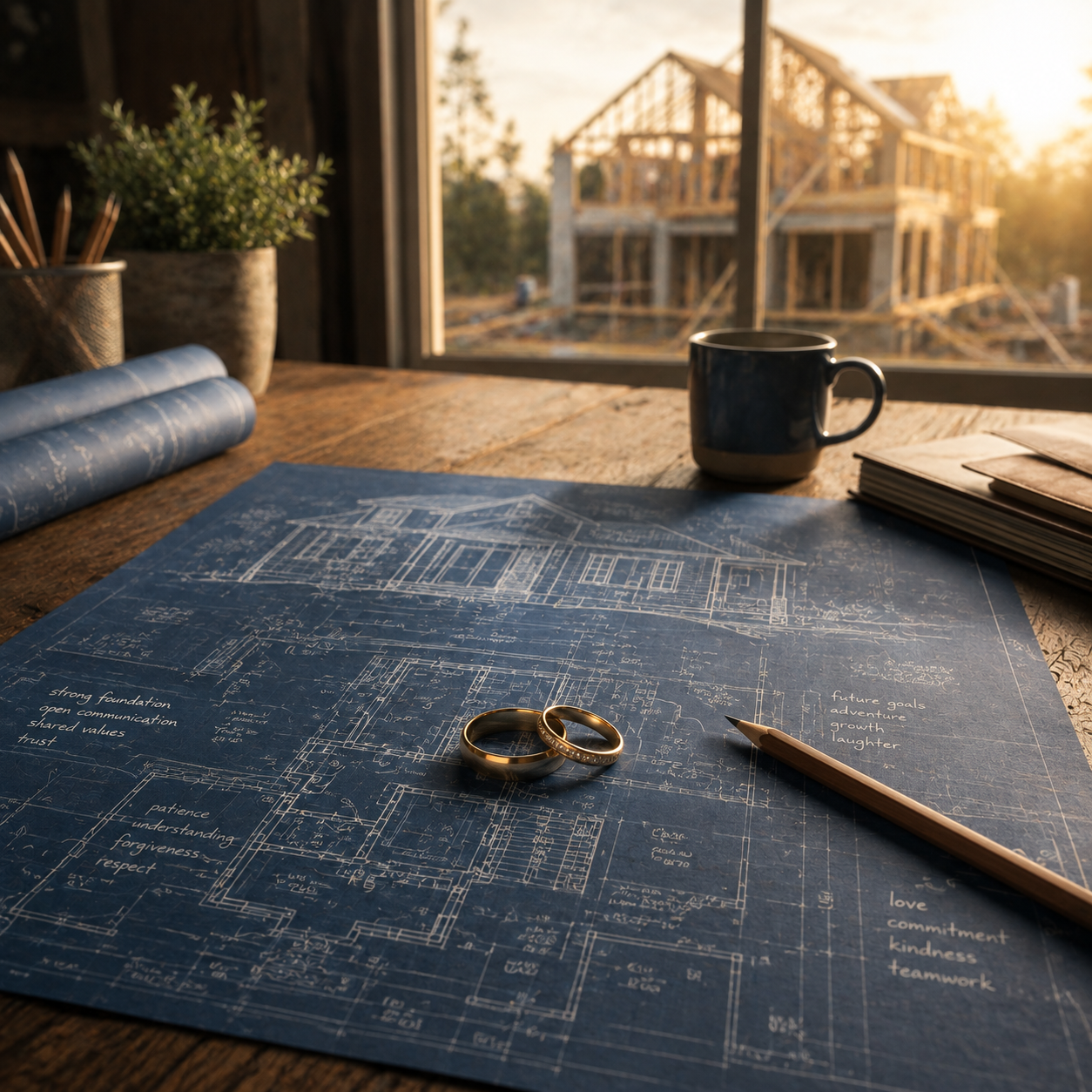
Why Every Relationship Has a Blueprint
1.
Why Every Relationship Has a Blueprint
Imagine asking three architects to design a family home.
They all receive the same brief.
Three bedrooms.
A kitchen.
A lounge.
A garden.
A garage.
By the end of the week, you’d probably have three very different designs.
Not because one architect is right and the others are wrong.
Because every architect brings their own experience, preferences and philosophy to the drawing board.
Relationships are no different.
None of Us Starts with a Blank Sheet
One of the ideas I often explore in my workshops is that every one of us carries a relationship blueprint.
The interesting part?
Most of us didn’t draw it.
It was handed to us, piece by piece, long before we ever fell in love.
Some of it came from our parents.
Some from previous relationships.
Some from the films we watched, the books we read and the stories we absorbed about what love “should” look like.
Some even came from things that were never spoken out loud.
The way conflict was handled.
The way affection was shown.
The way trust was built, or broken.
By adulthood, we’ve each collected a set of invisible plans for how relationships are supposed to work.
The challenge is that we often don’t realise we’re following them.
When Two Blueprints Meet
Here’s where it gets interesting.
Two people can deeply love each other…
…and still have completely different blueprints.
One person’s blueprint might say:
“If something’s wrong, we need to talk about it immediately.”
The other’s might say:
“If something’s wrong, give me space to think before we talk.”
Neither blueprint is automatically right.
Neither is automatically wrong.
They’re simply different.
But if neither person realises they’re working from a different set of plans, it’s easy to assume the other person is being difficult.
In reality, they may simply be building from a different design.
The Engineer Doesn’t Blame the Blueprint
When I worked in engineering, if a machine wasn’t producing the expected result, we didn’t shout at it.
We didn’t tell it to “try harder.”
We looked at the design.
Was it built for this purpose?
Had something changed?
Was there a better way to configure the system?
Relationships deserve the same curiosity.
When a pattern keeps repeating, I rarely start by asking:
“Who’s at fault?”
I’m much more interested in asking:
“What blueprint is producing this result?”
That’s a far more useful conversation.
The Rowing Boat
I often ask clients to imagine they’re sitting in a rowing boat.
You’re facing backwards.
You can clearly see where you’ve been.
But you can’t see where you’re heading.
Relationships are much the same.
Our blueprint is often behind us.
Our upbringing.
Our past experiences.
Our disappointments.
Our successes.
They’re all quietly influencing the direction we’re rowing, even when we’re focused on the future.
The goal isn’t to throw the blueprint away.
It’s to understand it well enough to decide which parts still serve the relationship you’re trying to build today.
A House Can Be Renovated
One of the reasons I like the blueprint metaphor is because it isn’t fixed.
Architects revise plans.
Builders renovate homes.
Engineers redesign systems.
In other words…
A blueprint isn’t a life sentence.
It’s a starting point.
You don’t have to keep living in a relationship that was designed by experiences you had twenty or thirty years ago.
You can redraw parts of the plan.
Not overnight.
Not perfectly.
But intentionally.
And that’s where real change begins.
The Perspective Shift
Perhaps the biggest relationship breakthrough isn’t finding the perfect partner.
Perhaps it’s recognising the blueprint you’ve been using all along.
Because once you can see the plan…
You finally have the freedom to redesign it.
Reflection
If your relationships had an architect’s blueprint…
What parts would you keep?
And what parts might be ready for a redesign?
Summary & Key Takeaways
- Every person brings a relationship blueprint into love.
- Those blueprints are shaped by family, experience, culture and beliefs.
- Many conflicts arise because two different blueprints meet without being recognised.
- Understanding your blueprint is more valuable than blaming yourself or your partner.
- Healthy relationships aren’t built by accident, they’re built with awareness, intention and a willingness to revise the plans.

Related Posts



Comments (0)