
When something keeps going wrong in a relationship, there's a question we naturally start asking:…
Why Good Intentions Still Hurt People
Why Good Intentions Still Hurt People
Have you ever apologised to someone and immediately followed it with:
“But I didn’t mean it like that.”
Most of us have.
And technically, you may be absolutely right.
You didn’t intend to hurt them.
You weren’t trying to dismiss them.
You weren’t deliberately making them feel unimportant.
But here’s the uncomfortable bit:
Your intention and their experience can both be true at the same time.
That’s where relationships get interesting.
We Judge Ourselves by Intention
Imagine you’re driving and accidentally reverse into somebody else’s car.
You get out and say:
“I’m so sorry. I didn’t mean to do that.”
That’s probably true.
Very few people deliberately reverse into another car.
But your intention doesn’t remove the dent.
You still have to look at what happened.
Relationships aren’t that different.
“I didn’t mean to upset you” explains your intention.
It doesn’t automatically repair the impact.
And this is where many perfectly decent people get stuck.
Good Intentions Can Become a Defence
When someone tells us we’ve hurt them, we naturally want to explain ourselves.
“That’s not what I meant.”
“You’ve misunderstood me.”
“I was only trying to help.”
Sometimes those explanations are important.
But notice what can happen.
The conversation moves from:
“This is what I experienced.”
to:
“Let me explain why you shouldn’t have experienced it that way.”
Suddenly, we’re no longer curious about impact.
We’re defending intent.
And the other person often feels even less understood than they did before.
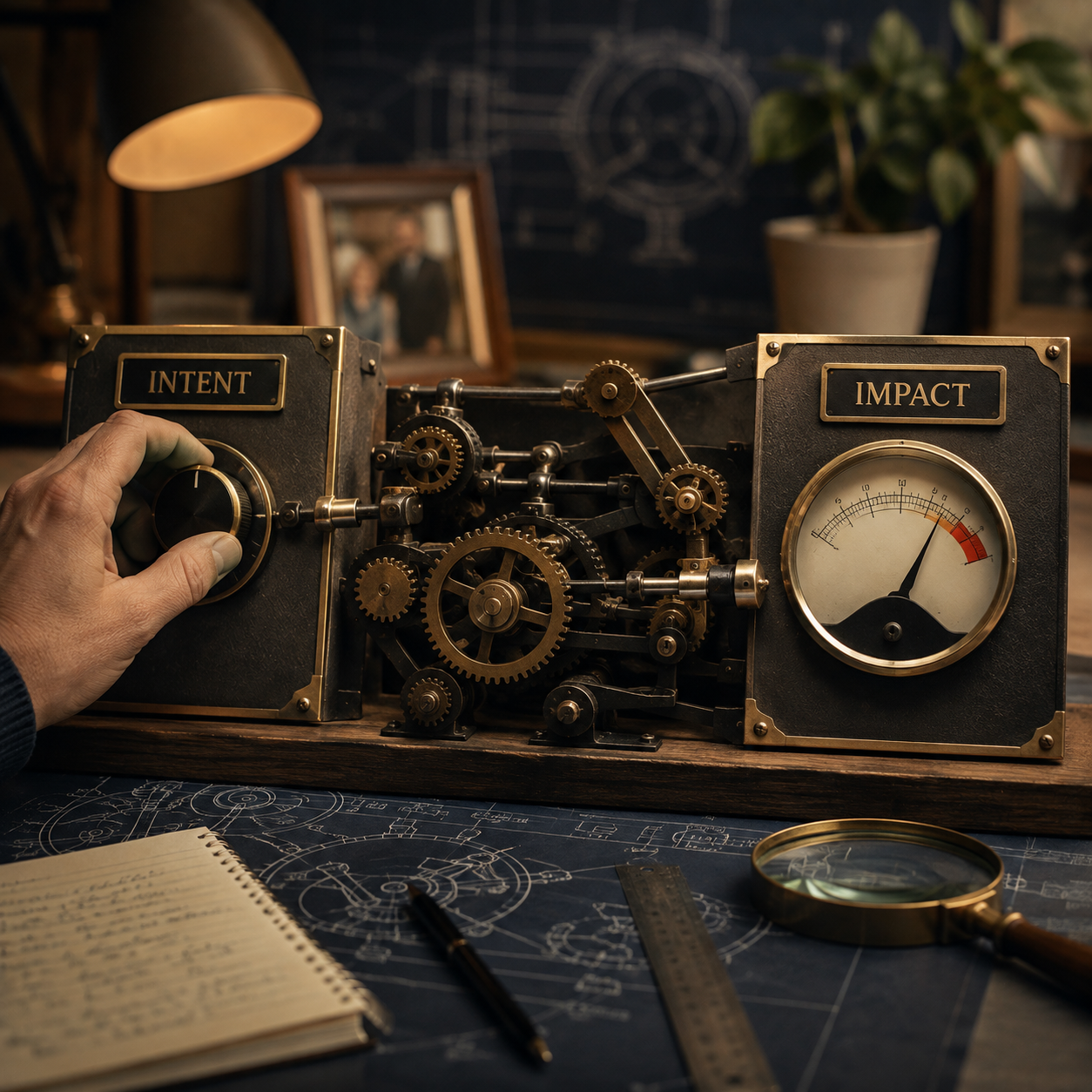
The Engineer Looks at the Output
Engineering taught me to be interested in results.
If a system is designed to produce ten units but consistently produces seven, telling me it was intended to produce ten doesn’t solve anything.
I need to understand what’s happening between the input and the output.
Relationships have inputs and outputs too.
You might put in:
Love.
Protection.
Advice.
Help.
But the other person experiences:
Control.
Criticism.
Pressure.
Not being trusted.
That doesn’t automatically make either person wrong.
It tells us something happened inside the system that deserves investigation.
That’s far more useful than deciding who the villain is.
Your Intention Still Matters
This isn’t an argument for saying intention is irrelevant.
Far from it.
There’s an enormous difference between deliberately hurting somebody and unintentionally causing hurt.
Intent tells us something about character.
Impact tells us something about the relationship.
We need both pieces of information.
It’s another version of something I talk about often: relationships aren’t 50/50.
They’re 100/100.
I’m responsible for what I intended.
I’m also responsible for being curious about the impact I had.
And you’re responsible for your interpretation, response and the meanings you attach to what happened.
That’s accountability without blame.
The Battery Principle
Think about a battery.
It needs a positive and a negative terminal before current can flow.
In this conversation, intention and impact can look like opposing terminals.
One person says:
“But I meant well.”
The other says:
“But it hurt.”
We tend to think one statement must cancel the other.
It doesn’t.
Both can exist.
The connection starts flowing again when there’s enough space for both truths.
“I believe you didn’t mean to hurt me.”
And:
“I believe that what happened hurt me.”
Now we have somewhere to go.
Repair Starts With Curiosity
Perhaps the most useful response when somebody tells you you’ve hurt them isn’t:
“But that’s not what I meant.”
Perhaps it’s:
“That wasn’t my intention. Help me understand how it landed for you.”
Notice what that does.
You’re not admitting to being a terrible person.
You’re not agreeing with every interpretation.
You’re not accepting responsibility for somebody else’s entire emotional world.
You’re simply becoming curious about your impact.
That’s Own Your Impact in practice.
And once somebody feels understood, there’s much more room to explore what you actually intended.
The Perspective Shift
Good people can hurt people.
Loving partners can misunderstand each other.
Kind intentions can produce painful outcomes.
None of those statements require blame.
They require curiosity.
Because perhaps the measure of a healthy relationship isn’t whether we ever get it wrong.
Perhaps it’s what happens when somebody says:
“That hurt.”
Reflection
The next time somebody tells you something you did affected them, notice your first instinct.
Is it:
“Let me explain what I meant…”
Or:
“Help me understand what you experienced…”
What might become possible if understanding came before defending?
Summary & Key Takeaways
- Good intentions don’t automatically create good outcomes.
- Intention and impact can both be true at the same time.
- Explaining our intention too quickly can leave the other person feeling unheard.
- Own Your Impact doesn’t mean accepting blame; it means becoming curious about what your behaviour created.
- Healthy repair makes room for both intention and experience.

Related Posts



Comments (0)